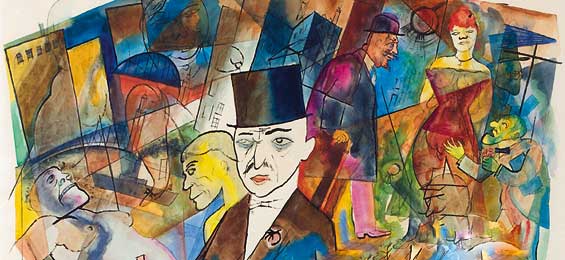
Set just after the end World War I, Just a Gigolo follows the journey of a young soldier turned drifter in Germany’s deprived capital.

David Bowie stars as Paul Ambrosius von Przygodski: a young Prussian man with the desire to become a hero and follow after his father’s military career. Instead, he wakes up in bed at a French hospital and everything has changed. The war has ended and it’s time to go back and resume life in Berlin, but how does a man with these ambitions do that without any medal of honour? The clue is in the film’s title.
For a bit of sociopolitcal context – 1918 was uncertain for men like Paul. Germany’s WW1 surrender plunged the country into hyperinflation, mass unemployment and a complicated democracy. So when Paul is given the opportunity to make money as a gigolo – naturally, he takes it.
As many men died in combat during the WW1, there was a shortage of men to dance with. Working as a Gigolo became common to amongst young, handsome men to make some money. Although sex was not expected, the gigolos could be paid to go on dates and accompany women, and then one thing could lead to another as long there was money. In fact, the famous Hotel Adlon common place to find Gigolos waiting to accompany women at the time.
Released in 1978, critical reception for the film was negative. Critics and audiences felt the film lacked substance, and its hard not to disagree with them here. It’s hard to imagine how Just a Gigolo could have done any better with the time period, location and characters.
A few years following its release, David Bowie said:
Everybody who was involved in that film – when they meet each other now, they look away [covers face with hands, laughs]… Listen, you were disappointed, and you weren’t even in it. Imagine how we felt… It was my 32 Elvis Presley movies rolled into one .
NME interview with Angus McKinnon, 1980.
Despite failing to impress audiences, I think there’s something to be said about bringing Marlene Dietrich out of retirement for $250,000. No longer the fun cabaret performer we’re familiar with like her cinematic debut in The Blue Angel, this is her final appearance in a film.
The original ‘Just a Gigolo’ song was an Austrian dance number from 1929 and takes us back to a time where people would go to ballrooms to dance and socialise. Here’s an English version of the song.
1930s Berlin had also flourished into a city famous for its underground nightlife, cabaret and more. It was the same world which introduced us to Marlene Dietrich and made her an icon. Just a Gigolo ‘s plot tries to parallels these Dietrich’s early life with the character of Paul’s on/off love interest, Cilly (Sydne Rome), the cabaret star who goes to Hollywood. Though, unfortunately, this subplot doesn’t do much to save the film drowning its own dreariness.
 Nadia Cheung