creative portfolio & blog

  • The Joker (2019)

    You’ve heard of DC Comic’s Batman, but how much do you know about the Joker?

    Arthur Fleck (Joaquin Phoenix) is a man in his 30s, isolated from society and living with his narcissistic mother in an apartment who is fixated with Gotham city’s billionaire and political candidate, Thomas Wayne (does the name sound familiar?). As we learn about Arthur, it becomes clear that he suffers from a neurological disorder, causing him to laugh uncontrollably for no particular reason. He’s an aspiring comedian and part-time party clown on thin ice because of the way he is.

    When footage of Arthur’s unsuccessful standup is shared on a talk show by the host, Murray Franklin (Robert DeNiro), Arthur Fleck is devastated and it becomes clear that this aspiration of a career in comedy may not happen. His behavioral traits and rejection from society initially make him a target of violence, and eventually, enough is enough. His murders are described in tabloids as politically motivated because the victims are linked to Thomas Wayne and his billion-dollar empire. This later incites civil unrest and violence in Gotham, dividing the ‘haves’ and the ‘have nots’, and is not dissimilar to riots and protests and show us how the Joker was once a vulnerable man before becoming the supervillain and antagonist to Batman.

    The Joker is a jack-of-all-trades kind of film: an origin story, psychological thriller, and a conversation about modern America’s rich and poor. Juaquin Phoenix’s performance of The Joker is physically evocative and well-deserving of the many awards won for this role. With elements of interpretive dance, extreme vulnerability, and pain, the story of Arthur Fleck is a cautionary tale about social deprivation, unresolved trauma, and mental health issues in a capitalistic society driven by money and power. It is, after all, set in the 1980s.

    With its original narrative and treatment of the very real themes that intersect our world today, director and co-writer Todd Phillips and the team succeed in making The Joker its own film without needing the Batman or other DC Comics characters to accompany the storyline. It took risks and was released at an unprecedented time when the Colorado shootings had happened, but despite this, it was one of the most successful films of 2019.

    P.S. If you’re a Batman fan, you’ll enjoy finding subtle references that may or may not connect the dots to the DC Comic realm.

  • Why Black Friday is a waste of time and money

    Black Friday has a totally different meaning to what it did when the term was first coined in 1952. In the United States, this particular day only received the same recognition we see today in 1980s, where the people of the United States would prepare to shop for Christmas. Since then, Black Friday has evolved into a clever business model to make more money and shift stock all over the world.

    Without sounding like a conspiracy theorist, here’s a list of reasons why you shouldn’t bother shopping on Black Friday.

    1. A false sense of urgency

    Did you know that sales on Black Friday have been proven to be amongst one of the most expensive date of the year? In a study analysing 6,000 products, it was found that prices were gradually increased weeks before Black Friday, resulting in an average discount of up to 5%.

    2. Buying for the sake of buying

    In a post-Marie Condo world, it seems we are constantly clearing out our homes and tossing the things that no longer serve a purpose all the time. Spring cleaning efforts are wasted as the weather gets colder and the days shorter in November, giving us all a reason to shop and trigger our brain’s reward centre for a boost of dopamine. And if it isn’t about the dopamine hit, then it’s the family pressure of getting gifts for Christmas to make someone happy.

    3. Costing the environment

    It may seem obvious but Black Friday is one of the most pollutive days caused by shopping. With the most influencing factor for shoppers to buy online being free shipping, competitors and retailers alike work hard to speed up the delivery process.

    In 2019, Amazon topped the charts and made a 54.9% of all sales on Black Friday. You can only imagine how much pollution was created through packaging and petrol alone to deliver items to buyers. Amazon already has a bad reputation for how much packaging is used, and year on year have made pledges that haven’t made much of a difference.

    5. There will be plenty of other opportunities to get a good deal

    Black Friday isn’t the only e-commerce sales day. Cyber Monday was born in 2005 to follow-up the momentum of Black Friday and offer discounted tech. And as of 2014, it has only gotten bigger and better.

    Another one was created too: Singles’ Day. Initially a student tradition created by Chinese students in the 90s to celebrate single life – Alibaba took Single’s Day as an opportunity to sell more products. This grew in popularity around the world, with 78 countries taking part in 2019 and those businesses made $38.4 billion.

    You can now find a way to buy anything you want on the internet. Black Friday doesn’t need to be a time to think about gifts or give in to the pressure. The dialogue surrounding gifts is thankfully changing, with families making pacts and finding other creative ways to spend time together this festive season. Don’t fall into the pressure to buy because you’re being reminded to.

  • 5 useful tips before going to Morocco

    I’ve compiled some advice to help prospective tourists have a good time wherever they go in Morocco.

    If you’re only planning to visit Marrakesh and want to do it well, you’ll need around 3 days. Looking for some ideas of where to go? Check out my Marrakesh highlights here.

    Planning a week-long holiday? I’d recommend exploring other cities and places further afield to the Atlas Mountains or nearby cities like Agadir, Casablanca, or Fez. There are regular trains at the Marrakesh train station and tickets can be purchased from 100 dirhams.

    1. Upon arrival, you’ll get an entry number in your passport

    Marrakesh Menara airport is pretty relaxed. Observe that the staff will chat amongst each other – to the point that you find yourself standing idly, waiting for them to finish their conversation and come back to you. That being said, staff at the airport will collect your passenger locator form (a special Covid-19 addition) without any questions.

    When you arrive at Customs and Immigration, the officer scrutinising you will take a picture of you and write in your passport. Pay attention to where it’s written because it will be important for checking into your hotel. There will be a field in your check-in form which will ask for an entry number. That’s when this note scribbled on your passport is important! Apparently, your entry number will remain the same and will be reusable for future trips back to Morocco.

    2. Get a Moroccan SIM card to save time and money

    If you have a smartphone that accepts any brand of SIM card, count yourself lucky. Instead of paying expensive international roaming rates to your provider, get yourself a prepaid SIM card from 20 Dirhams so you can move around freely.

    You can get a SIM card at any phone shop. I went with Orange located in Marrakesh train station and got enough data to last for only 25 Dirhams. Google Maps will be a godsend for finding local restaurants and famous historical sites around the city, which means you’ll see and do more without needing to ask for directions or use international roaming.

    3. Dirhams are everything – make sure you have enough cash with you.

    You’ll need Moroccan dirhams (MAD) to get around Marrakesh. Some tourist places do take card payments but there isn’t always a guarantee.

    The best place to get cash upon arrival is at the airport. You have options to withdraw at an ATM (with small service charges on top) or swap money with the currency exchange there. It’s best to get enough cash to last a few days to avoid unexpected charges that can go as high as £20 on top of your withdrawal from a random ATM.

    Pro tip: It will help your budgeting to make a note of the exchange difference between Moroccan Dirhams and your local currency. Cash notes are in denominations of 20, 50, 100, and 200 dirhams while you’ll also have change in 5 and 10 centimes, and 1, 2, 5, and 10 dirham coins. Oh, and ALWAYS hide some cash somewhere on you in case you suddenly run out. This will be essential if you get carried haggling left right and centre in the souks!

    Getting a taxi from the airport? It should only cost 80 to 150 Dirhams for a 10-minute drive. Be warned of some drivers who will state a much higher price. It’s natural to haggle in Morocco so don’t be afraid to push for a lower fare. I wish I learned this sooner because we paid 400 dirhams for a taxi, which was obviously a total rip-off.

    4. Food portions are enormous

    There’s so much food to enjoy in Marrakesh, the best-known dishes are the famous tagine, couscous, and a varied selection of mezze sharing dishes. Portion sizes for some dishes are enormous, so you might need to keep this in mind when it’s time for a meal. Ask your waiter how big the dish is and if you’re not a big eater or travelling alone, pick one meal to share instead.

    If you’re on a tight budget and prefer to eat somewhere that doesn’t have many tourists, head over to where the cafes are. There are a few located near Jemma el-Fnaa and the remains of El Badii-Ksibat Nhass Palace. They’ll do baguettes and kebab-like dishes for a really cheap price (approx. 30 MAD).

    5. Find excursions online to save time and money

    There’s a lot of things to do in Marrakesh, but it’s important to remember you don’t have to go for the first excursion you see advertised.

    For only £25, I booked a day trip to explore the Atlas Mountains, have lunch, and ride a camel. This was all organised with a local tour guide on Tripadvisor.

    So if you’re on a budget, search for the trips you want to do online. I promise it won’t take away the spontaneity. There are so many competitive offers online which have a clear itinerary for a fixed price.

  • Spending a long weekend in Marrakesh

    The most-visited city in Morocco has an abundance to see and do. If you’re looking for some travel inspiration and advice, read on to explore the highlights!

    Places to explore

    Jemaa el-Fnaa - Wikipedia

    Jemaa el-Fnaa

    This is the square which has absolutely everything you’ll need as a tourist: souvenirs, food, and people-watching. Rooftop terraces will be the best place to view this bustling square. Things to spot: freshly squeezed fruit juice, henna stalls, cobras, and monkeys.

    El Badii-Ksibat Nhass Palace

    What initially seems like a grand fortress is actually the remains of a palace built by the Saadian dynasty back in 1578. It’s now known as an exhibition centre for the occasional event. When venturing by foot, you’re never far from the Kutubiyya Mosque and Jemma el-Fnaa.

    brown concrete building

    Bahia Palace

    Marvel at the intricate details of this beautiful late 19-century palace tucked away from the chaos. What’s most fascinating is that the palace was not only home to the before grand vizier (ruler) Ba Ahmed ben Moussa, it also housed his 4 wives, a harem of 24 concubines, and their children all at once.

    It’s hard to imagine how grand the palace was in its former glory as all the furnishings were stolen in 1900 following his death, but you can only imagine with there being so many rooms and lush gardens.

    You can enter the palace for 70 dirhams.

    blue and brown wooden signage on black steel frame

    Souks!

    These are markets with all kinds of goods for sale: from beauty to one-of-a-kind pieces of art. To haggle, always stand by your lowest price and never budge, even if it’s a ridiculous amount. Your seller will level with you. You could get lost but it won’t be boring. We found a mother of kittens at a beauty stall deep inside one of the souks.

    To haggle, always stand by your lowest price and never budge. Your seller will level with you unless something is clearly stated for a fixed price. If you’ve never haggled before, these are the best principles to go by and the rest will come naturally.

    Make sure to avoid directions, advice, or talking to random strangers in the souks. It’s commonplace for beggars to try to trick you through an act of kindness in exchange for money. They may vary in their approach, but the best thing to do is ignore anyone who approaches you out of nowhere.

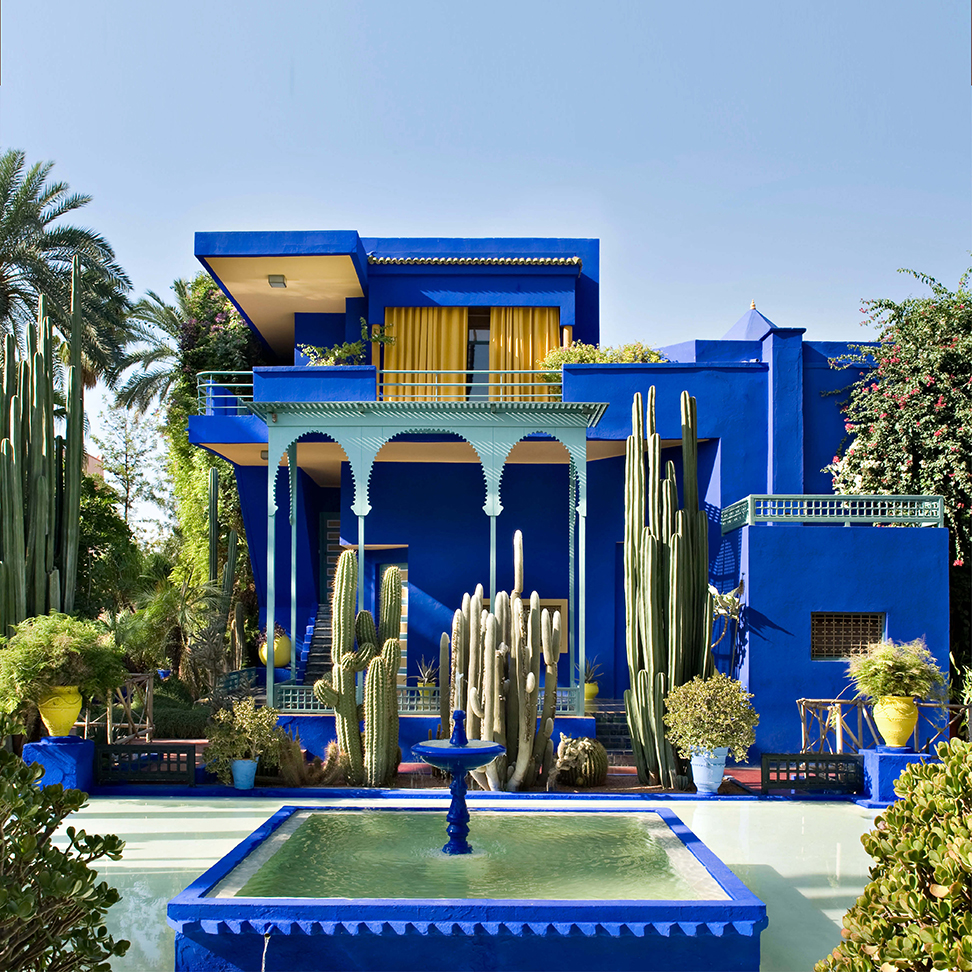
    Jardin Majorelle

    Jardin Marjorelle

    This was my favourite place in Marrakesh. Located next door to the Yves Saint Laurent museum, Jardin Marjorelle is a botanical garden with some a bit of history. Previously owned by painter Jacques Marjorelle in 1923, the villa and garden fell into disrepair after his death. In the 1980s, Yves Saint Laurent bought the place with his life partner, Pierre Bergé who restored it to the condition it is now. Since their passing, the property houses several exotic plants a museum dedicated to Berber art, and a memorial where the ashes of the iconic fashion designer and his partner were scattered.

    Entry to the garden costs 120 MAD and proceeds go directly to funding the arts and paying as well as paying the staff a decent wage and maintaining the garden.

    If you’re keen to visit, I’d recommend making enough time to enjoy looping through the garden a few times before heading to the cafe with lovely water mists to cool down. Order a refreshing mint tea (a symbol of friendship) for a delightful surprise from your waiter.

    The Atlas Mountains

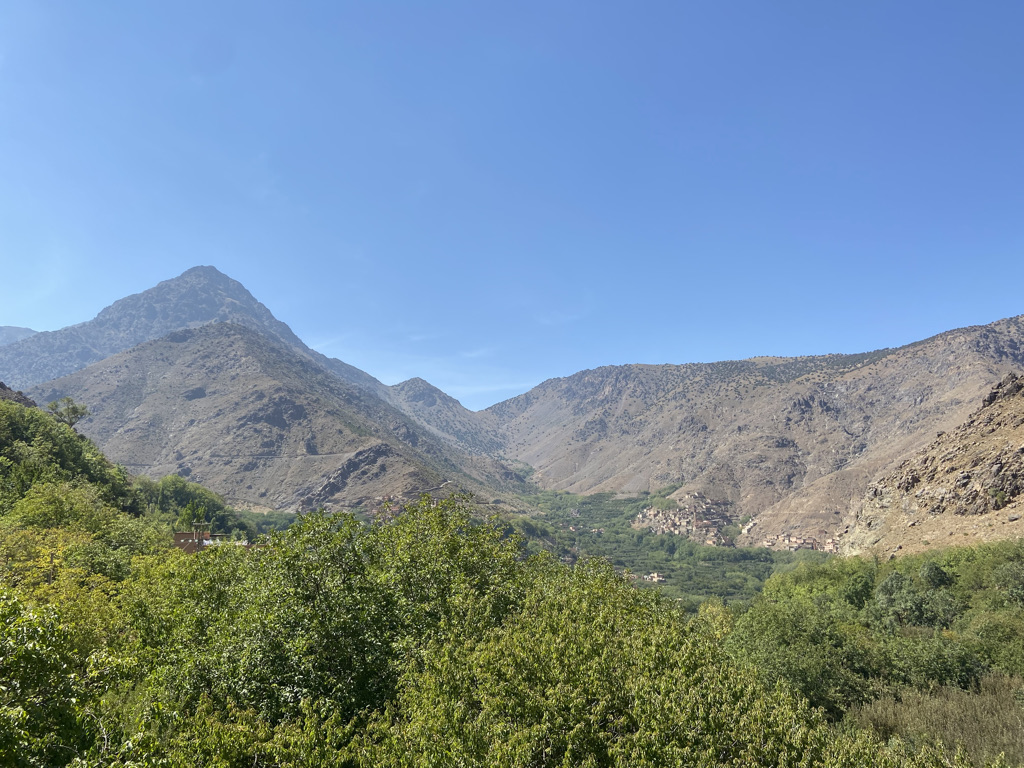
    While it’s not exactly in Marrakesh, an excursion to the Atlas Mountains is worthy of a day trip out of the city. Taking about an hour or so to drive there, we visited Asni and hiked along the valleys, and immersed ourselves into the Berber way of life.

    Tempted to add Marrakesh to your travel wishlist? Check out my 5 useful tips before going to Morocco.